Introduction
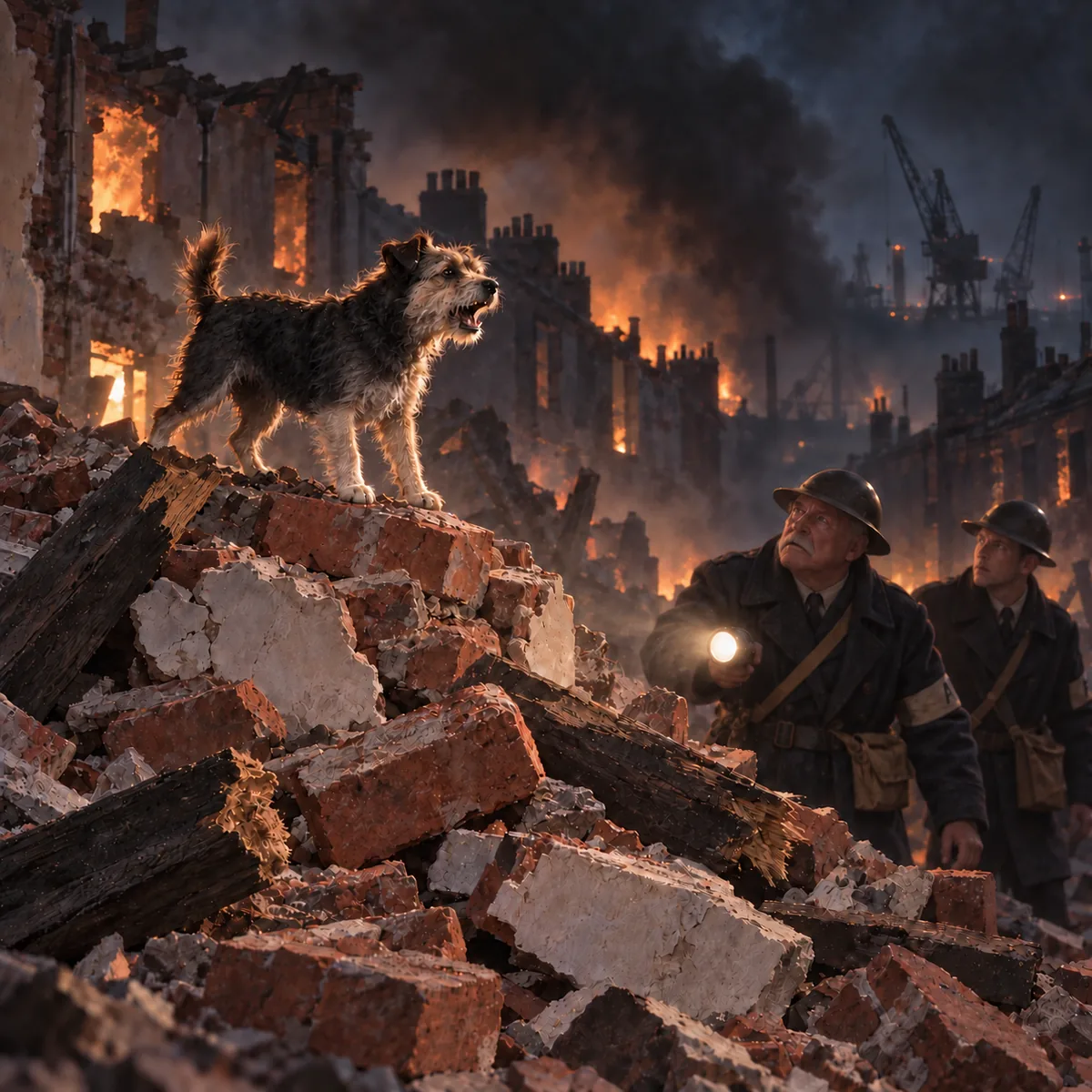
Rip’s work was not one dramatic rescue on one famous date. During the London Blitz, he accompanied civil-defence workers into streets damaged by repeated air raids and helped find people beneath collapsed buildings. A stray dog taken in by an air-raid warden, he learned no formal search course. His wartime role grew out of what the wardens saw him do.
The figure most often attached to Rip is “more than one hundred” people helped in a year. It is a later PDSA estimate, not a surviving list of named rescues. The safer historical measure is the one in his Dickin Medal citation: he located many air-raid victims during the 1940 Blitz.
Historical Context
German bombing of London began in earnest in September 1940 and continued into 1941. When houses or factories collapsed, civil-defence teams had to locate the living among rubble, smoke, dust, and unstable walls. Air Raid Precautions wardens worked with rescue crews, firefighters, ambulance workers, and neighbors. They could hear calls and search likely voids, but a dog’s nose could direct attention to places a person might miss.
Rip’s beat was Poplar, in London’s East End. The area’s docks and housing suffered heavily from bombing. PDSA places him with the Southill Street Air Raid Patrol, post B132. These details matter because they locate a celebrated animal within a local human network rather than imagining him working alone.
The Story
In 1940 a local warden, Mr. E. King, found Rip hungry and alone after an air raid. King fed him and took him into the Southill Street team. Rip initially became their mascot. As they responded to bomb damage, the dog repeatedly showed a talent for finding trapped people. The PDSA’s account says he had no formal rescue-dog training and became an unofficial search-and-rescue dog through practice.
Working a collapsed building meant listening to the dog, checking where he indicated, and then doing the dangerous excavation. Rip’s contribution was locating potential casualties; human crews still had to reach them. PDSA describes his progression from mascot and unofficial search dog to the ARP’s first “official” rescue dog, while noting that he had no formal training.
Rip’s rescues accumulated over months. PDSA says he is believed to have helped save more than one hundred people in twelve months. That estimate conveys the scale of his reputation but cannot be used to reconstruct a daily rescue log. No reliable source places all his work on a single anniversary date, and the most truthful timeline is the repeated Blitz service of 1940–41.
What We Know — and What We Don’t
Rip’s association with King, Poplar’s Southill Street ARP post, his untrained work locating victims, and the 1945 Dickin Medal are supported by the medal-granting body. The precise total of rescues is an attribution from later PDSA history. It may count people Rip indicated, people extricated with a team, or a wider set of rescues; the cited source does not give a names list or method. “More than one hundred” should therefore always be introduced as a credited or believed figure.
What Happened Afterward
Rip received the PDSA Dickin Medal in 1945. Its citation honors him for locating many air-raid victims during the Blitz of 1940. He wore the medal on his collar and was later buried in the PDSA Animal Cemetery at Ilford. His story also became part of a wider recognition that trained search dogs could assist disaster rescue, although modern search-and-rescue practice developed through many people and animals beyond Rip alone.
From History to Song
“Beneath the Stones” is about the sustained attention required to find life where destruction hides it. Rip’s history gives the song a setting of streets, wardens, and rescue crews rather than a single invented scene. The emotional focus is hope carried through repeated nights of bombing: a dog pausing at rubble, people trusting the signal, and a team working to reach whoever remained below.
The song's title suggests the physical weight that separated trapped people from help. Rip could point a team toward a person, but rescuers then had to move dangerous debris. Both parts of that work belong in the memory of the Blitz.
Key Facts
- Animal: Rip
- Species/breed: Crossbreed terrier
- Conflict: Second World War, civilian home front
- Country/unit: United Kingdom; Southill Street Air Raid Patrol, Poplar, London
- Role: Casualty-finding rescue dog
- Key date(s): 1940–41 Blitz service; 1945 Dickin Medal
- Location(s): Poplar, London; later buried at Ilford
- Known for: Locating people beneath bomb-damaged buildings without formal training
- Recognition/award: PDSA Dickin Medal, 1945
Sources & Further Reading
- “Rip — Dickin Medal 27”, PDSA, award and biographical account, 1945 citation.
- “Celebrating VE Day with some animal heroes”, PDSA, 2020.