Introduction
Dzhulbars is remembered as a Soviet dog trained to detect mines and unexploded shells in the last phase of the Second World War. A frequently repeated total credits him with finding 7,468 mines and more than 150 shells between September 1944 and August 1945. That precision is striking. It deserves attribution to the secondary study that reports it, rather than being treated as a figure independently verified from a digitized dog service log.
A second story is more famous in some places: that, wounded, Dzhulbars was carried across Red Square at the 1945 Victory Parade on Stalin’s coat. A 2022 study reports finding no contemporary visual or radio evidence for that scene, or documentation for the associated medal claim. The real mine-detection work should not be overshadowed by a later legend.
Historical Context
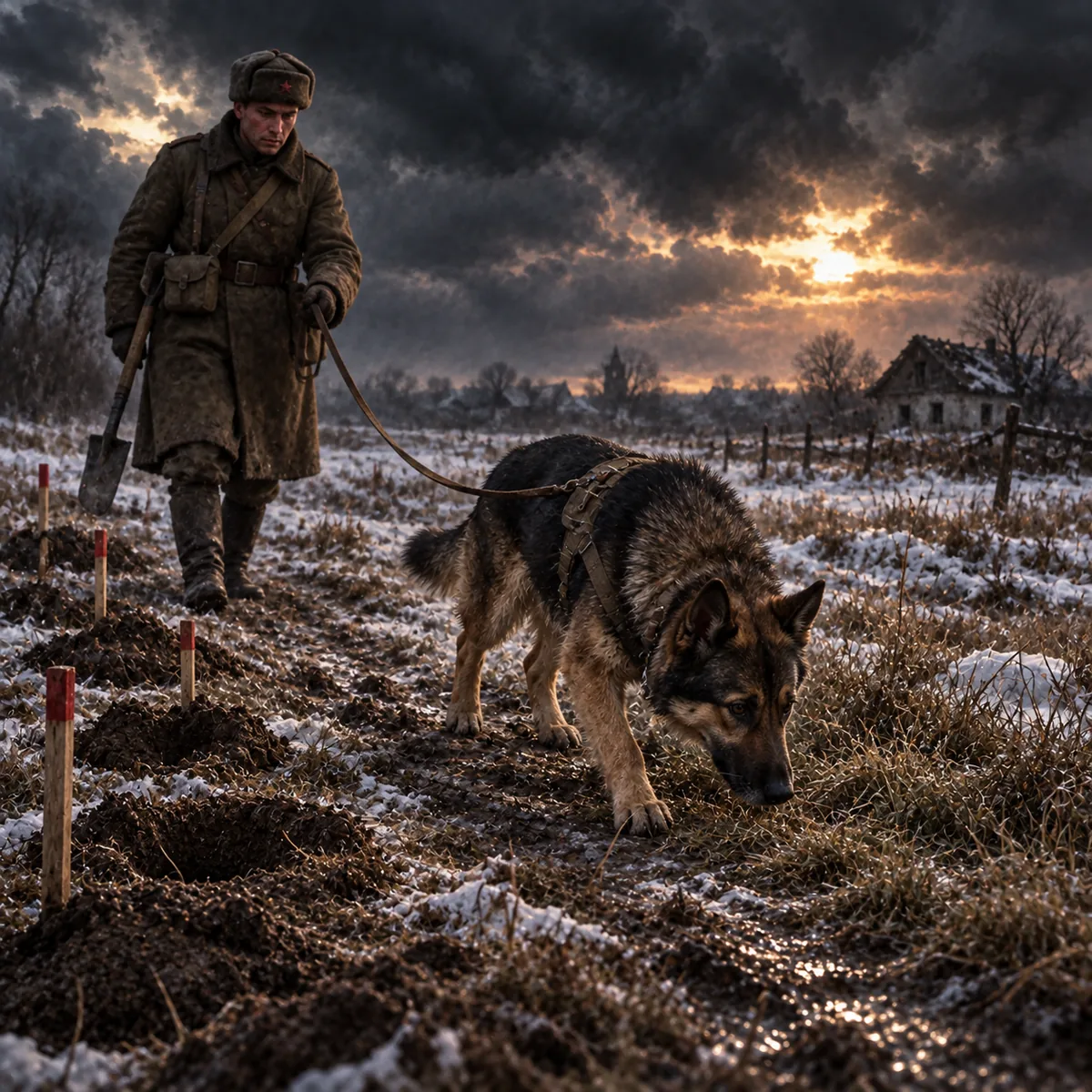
As Soviet forces advanced west in 1944–45, engineers faced mines and unexploded ordnance left in roads, fields, settlements, and important buildings. Clearing them was laborious and dangerous. A trained dog could locate explosives by scent and alert a handler, who then investigated and removed the threat. The work continued after fighting passed because explosives remained dangerous to soldiers and civilians.
Dzhulbars was associated with trainer Dina Volkats and the Soviet military dog service. A Russian historical article by Sergey A. Voronov and Alexander V. Borodavko, “1945 Victory Parade: Common Misconceptions, Myths and Facts”, cites information from the Central Archive of the Russian Ministry of Defence about Dzhulbars’ service. It places operations in Romania, Hungary, Czechoslovakia, and Austria.
The Story
According to that study, from September 1944 through August 1945 Dzhulbars participated in clearance work across those countries and was credited with 7,468 mines and more than 150 unexploded shells. The account does not reproduce the underlying individual tally sheets or identify each site in a way a reader can independently audit. The numbers are therefore presented here as a tally reported by the authors, not as a fresh count by Mortal Archive.
The geography is as important as the headline total. These were not discoveries in one field or one battle; the reported service spans multiple countries and a period that continued beyond Germany’s surrender in May 1945. Mine detection is a partnership between dog and handler, followed by the hazardous labor of sappers. Dzhulbars could identify a danger; trained people still had to make the area safe.
Stories often attach famous sites in Vienna or Prague to him. Some may reflect genuine clearance assignments, but the consulted article does not document a site-by-site itinerary. Naming a particular cathedral or palace as personally saved by Dzhulbars would turn a broad operational record into an unsupported anecdote. This article leaves those claims out.
What We Know — and What We Don’t
The mine and shell figures, period, and four-country scope come from a scholarly article that says it relies on Russian defence-archive information. The article supplies neither an archival file reference nor scans for the tally, so the exact figure remains an attributed claim. The English journal page below describes the publication; the article link holds the Russian full text. They provide no independent corroboration. Its discussion also includes polemical claims about the people who repeated the parade story. It should be read critically rather than treated as a substitute for the records themselves. The authors report finding no contemporary visual or radio evidence for the Stalin-coat story. They also report finding no documentary award record proving that Dzhulbars received a Soviet Medal “For Battle Merit.” The dog’s work can be honored without listing that unverified medal as fact.
What Happened Afterward
The later life and death date of Dzhulbars are not established by the consulted study. His public legacy is unusually divided: mine-clearing totals are widely circulated, while the dramatic parade scene has spread despite weak evidence. Careful commemoration keeps the former attributed and the latter labeled as legend. It also remembers the larger Soviet dog-and-handler teams who searched for explosives long after front lines moved on.
From History to Song
“Clear the Path” focuses on danger that remains after a battle appears finished. Its emotional center is the slow, repeated search that allows people to return to a road, a town, or a building. Dzhulbars’ story provides a different kind of courage from the album’s charges and messenger flights: patient detection alongside a handler. The song does not need Stalin’s coat to make that work memorable.
The precise mine figure can draw attention, but the path itself is the stronger image: a route made safer one alert at a time. The article keeps the number attributed to the authors who report it and gives no invented individual mission day.
Key Facts
- Animal: Dzhulbars
- Species/breed: Dog; shepherd type reported, exact breed uncertain
- Conflict: Second World War and immediate postwar clearance
- Country/unit: Soviet Union; military mine-detection service, associated with trainer Dina Volkats
- Role: Mine and unexploded-ordnance detection
- Key date(s): September 1944–August 1945, reported tally period; exact individual missions not established
- Location(s): Romania, Hungary, Czechoslovakia, Austria in the cited secondary account
- Known for: Reported detection of 7,468 mines and more than 150 shells
- Recognition/award: Soviet military medal claim unverified; Victory Parade coat story is unverified
Sources & Further Reading
- Science. Society. Defense — English journal page, English overview of the journal; this page does not contain the Dzhulbars article.
- “Парад Победы 1945 г.: распространенные заблуждения, мифы и факты” / “1945 Victory Parade: Common Misconceptions, Myths and Facts”, Sergey A. Voronov and Alexander V. Borodavko, Science. Society. Defense 10(3), 2022; Russian full text citing Central Archive of the Russian Ministry of Defence information. The article page includes an English title, abstract, and references, but not an English translation of the full text.