Introduction
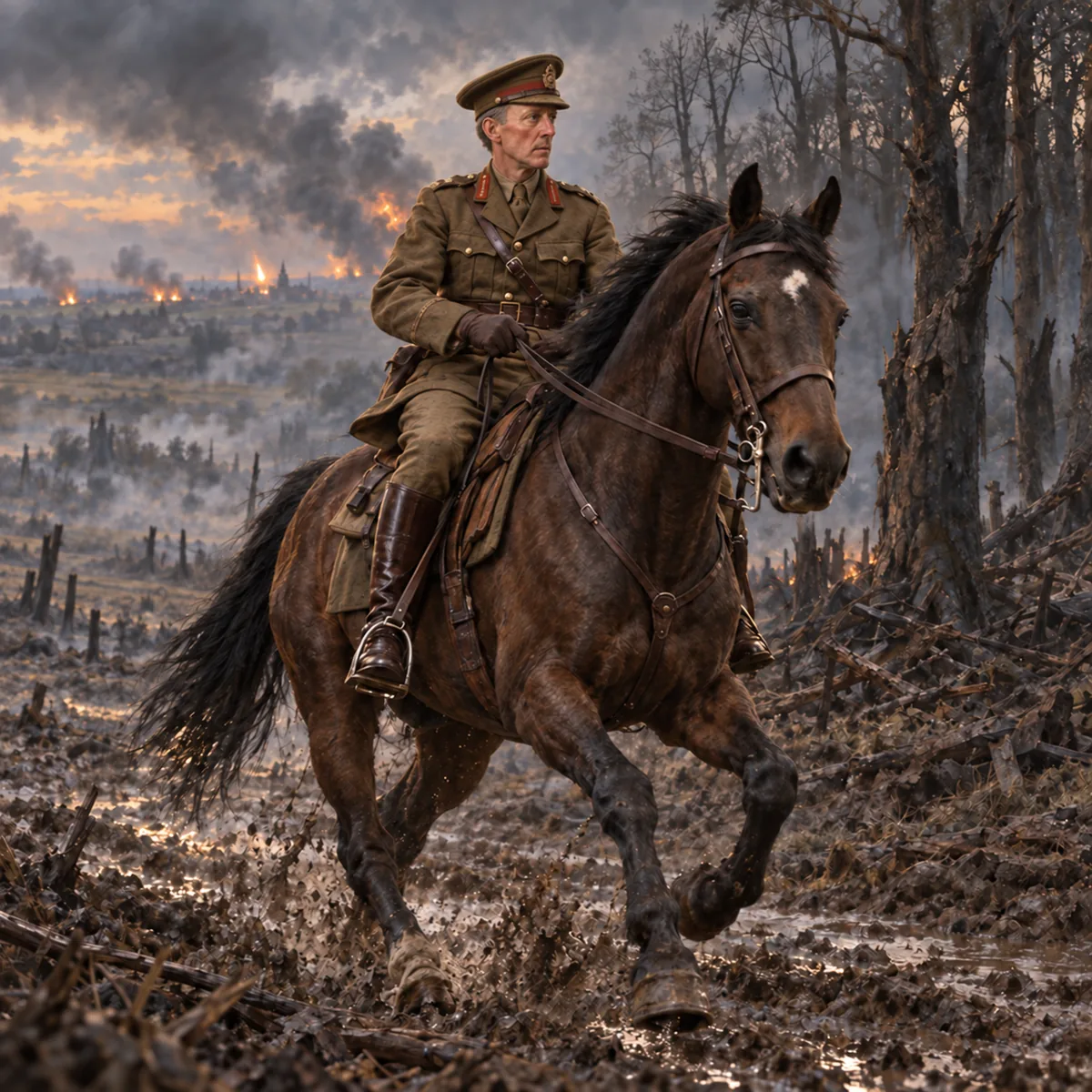
Warrior went to the Western Front with Jack Seely in 1914 and came home at the end of the First World War. The horse survived years of shellfire, movement, and dangerous cavalry service. A later newspaper phrase called him “the horse the Germans couldn’t kill.” His survival through that war became closely associated with Seely, though he did not spend the whole conflict with one rider. The family history records that Warrior remained in France as another officer’s charger after Seely was gassed in April 1918.
His most famous day is 30 March 1918, when Seely’s Canadian Cavalry Brigade fought at Moreuil Wood. The battle included a costly mounted charge led by Lieutenant Gordon Flowerdew. Warrior was Seely’s horse; he should not be confused with the horse in every depiction of Flowerdew’s squadron.
Historical Context
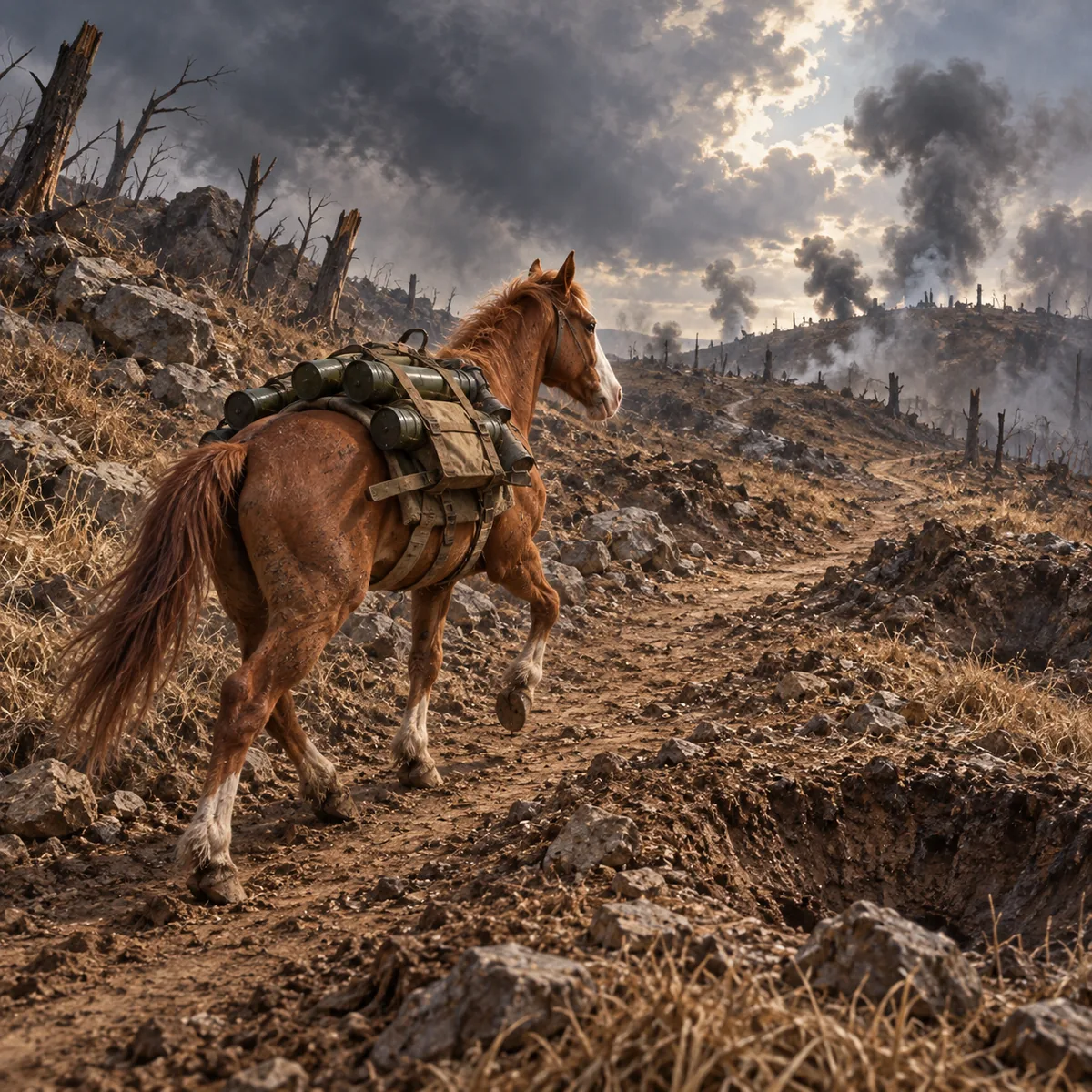
Horses carried soldiers, hauled guns and supplies, and enabled rapid movement even in an increasingly mechanized war. The Western Front was particularly hard on them: mud, poor forage, shellfire, and exhaustion were constant risks. Cavalry could still be useful for reconnaissance and mobile response, but machine guns and artillery made mounted attacks perilous.
In March 1918 Germany launched a major offensive. Allied forces tried to stop advances around Amiens. At Moreuil Wood on 30 March, parts of the Canadian Cavalry Brigade fought dismounted while a squadron of Lord Strathcona’s Horse charged German infantry. That distinction matters: the battle was not one simple cavalry sweep.
The Story
Seely had bred Warrior on the Isle of Wight and rode him to war. During 1914–18 the pair moved through several major campaigns. The PDSA’s Warrior account describes burning stables, burial in rubble and mud, and frequent exposure to gunfire. Those episodes derive largely from Seely’s memoir and family tradition. They are credible as recollections of an officer and his horse, but their exact dates and settings are not all independently fixed by the sources used here.
At Moreuil Wood Seely commanded the Canadian Cavalry Brigade. A UK Parliament biographical account specifically associates Seely and Warrior with the charge. The Canadian War Museum’s account of Flowerdew’s squadron records the squadron’s severe losses. It is important not to transfer Flowerdew’s action or casualty figures to Seely’s personal horse. Warrior’s role was to carry Seely through the brigade’s battle, not to single-handedly win it.
The fact of Warrior’s survival is inseparable from care. Horses were fed, groomed, moved, and treated by soldiers and stable staff whose work often disappears from heroic portraits. His continued service reflects both his constitution and the human labor that kept him fit enough to travel and carry a rider.
What We Know — and What We Don’t
The 1914–18 service, Seely relationship, Moreuil Wood date, return home, and later commemoration are supported by museum and parliamentary sources. Details of individual near misses depend heavily on Seely’s 1934 memoir and later family presentations; they should be framed as recollection rather than independently recorded battle incidents. Sources also disagree on whether Warrior was a stallion or gelding: the PDSA calls him a stallion, while the family site calls him a gelding. Both descriptions identify a male horse; whether he was gelded remains unresolved in the consulted sources.
What Happened Afterward
Warrior returned to the Isle of Wight with Seely. PDSA records that he won a point-to-point race in March 1922 and died in 1941. In 2014 the charity gave him an honorary Dickin Medal on behalf of all animals who served in the First World War. This was a retrospective honor: the Dickin Medal did not exist during Warrior’s wartime service. His portrait by war artist Alfred Munnings and Seely’s memoir helped carry his story into later generations.
From History to Song
“Ride On” looks beyond the spectacular instant of a cavalry attack to the years before and after it. Warrior’s service offers a story of endurance under a rider who knew him intimately, against the scale of animal suffering in the war. The song can hold the surge of Moreuil Wood and the quieter fact of coming home together, while keeping the histories of Seely, Flowerdew, and their horses distinct.
That return is central to the track's sense of duration. Warrior lived more than two decades after the battle, and his later race and family memories stand beside the wartime portrait. They show a horse's life extending beyond what the army required of him.
Key Facts
- Animal: Warrior
- Species/breed: Thoroughbred horse; sources differ on whether he was gelded
- Conflict: First World War
- Country/unit: United Kingdom and Canadian Cavalry Brigade; ridden by General Jack Seely
- Role: Cavalry officer’s mount
- Key date(s): 1914–18 service; 30 March 1918, Moreuil Wood; 1941, death
- Location(s): Western Front, France; Isle of Wight, England
- Known for: Service during 1914–18, including carrying Seely at Moreuil Wood
- Recognition/award: Honorary PDSA Dickin Medal, 2014, on behalf of First World War animals
Sources & Further Reading
- “Warrior”, PDSA, honorary Dickin Medal account, 2014.
- “Cavalry on the Western Front”, National Army Museum, historical essay, date not stated.
- “J.E.B. Seely (1868–1947)”, UK Parliament, First World War biography, 2014.
- “Charge of Flowerdew’s Squadron”, Canadian War Museum, collection essay, date not stated.
- “About Warrior”, Brough Scott / Warrior War Horse, family history, date not stated.