Introduction
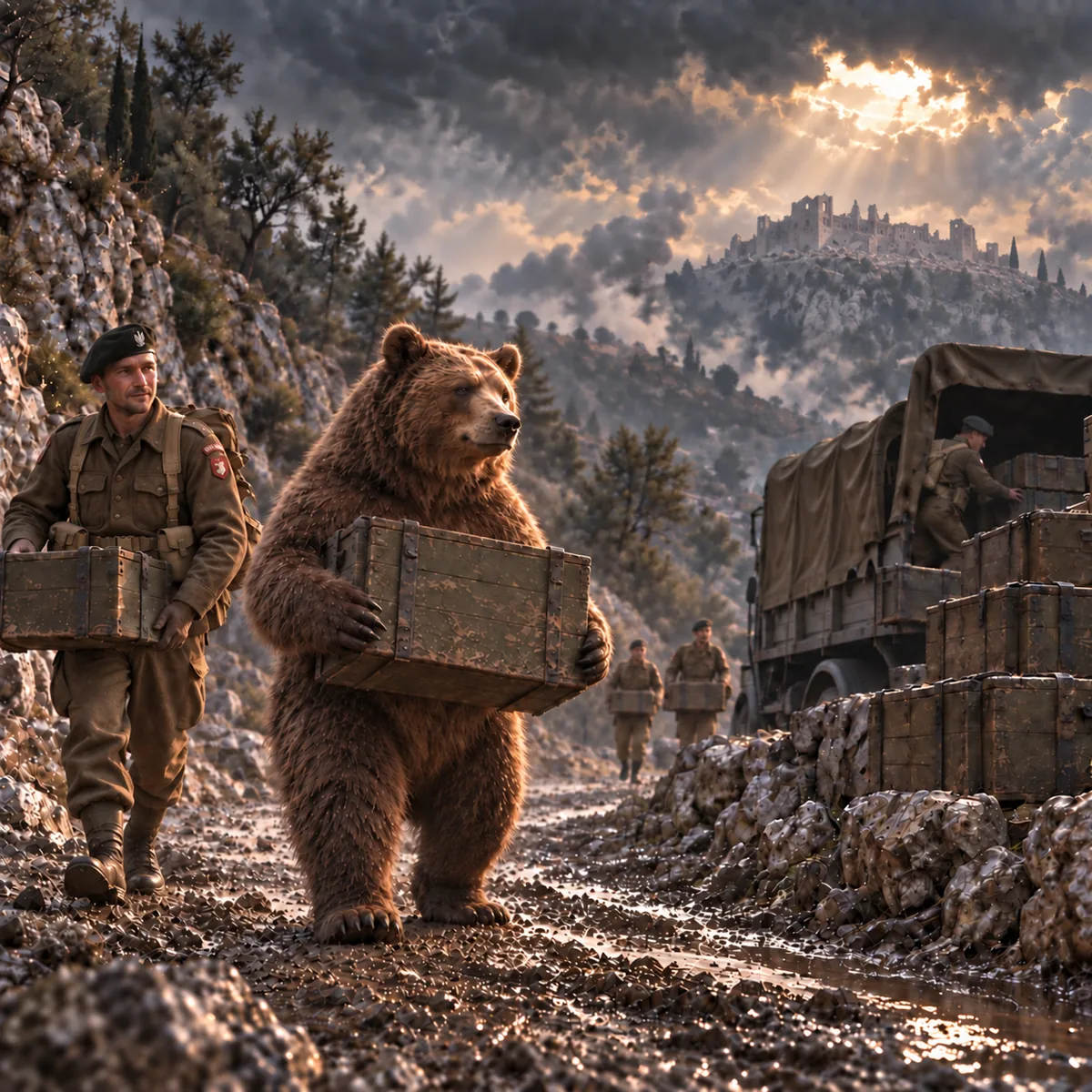
Wojtek was a Syrian brown bear who travelled with Polish soldiers through the Middle East and Italy during the Second World War. He belonged in the daily life of the 22nd Artillery Supply Company of the Polish II Corps, a unit whose work kept guns supplied during the difficult Italian campaign. At Monte Cassino he reportedly helped move ammunition containers, and his image became the company’s emblem.
The account has acquired many bright anecdotes, some better grounded than others. A historically useful telling keeps the bear in the larger story of Poles uprooted by war, the soldiers who raised him, and the supply work for which they remembered him.
Historical Context
The Polish II Corps, commanded by General Władysław Anders, included many people who had been imprisoned or displaced in the Soviet Union after the 1939 invasions of Poland. After leaving Soviet territory, they organized and trained in the Middle East before joining the Allied campaign in Italy. Their attack at Monte Cassino formed part of the long effort to break German defensive lines south of Rome. The Polish assault culminated in the capture of the ruined monastery area on 18 May 1944.
Artillery depended on people, vehicles, and supply units moving heavy ammunition forward. The 22nd Artillery Supply Company’s role was logistical rather than glamorous. That is precisely why Wojtek’s story matters: even the most famous animal in the unit is remembered in connection with the supply work that sustained the battle.
The Story
Polish soldiers acquired Wojtek as a cub in the Middle East and raised him among them. He travelled with the unit and became a mascot and companion. The Polish Institute of National Remembrance identifies him as a Syrian brown bear with the 22nd Artillery Supply Company and says he carried ammunition boxes and pulled a supply cart during the Monte Cassino battle. An Imperial War Museums collection record preserves a commemorative plaque by Otto Maciag associated with Wojtek and the company. The plaque records his place in military remembrance; it is not a wartime loading record.
Formal registration as a soldier is part of Wojtek’s history in Polish institutional accounts. The precise administrative step and rank are often retold as a clever way to get him aboard a troopship; without the personnel document in hand, the article does not give a service number or invent a boarding exchange. The important verified point is that the company regarded him as part of its community and later adopted the image of a bear carrying a shell as its insignia.
During the Polish assault at Monte Cassino in May 1944, the supply company moved ammunition toward the guns. Institutional histories credit Wojtek with helping that work. The sources consulted here do not document each journey or the contents of individual loads, so the article does not assign him a precise ammunition total.
What We Know — and What We Don’t
Wojtek’s existence, company association, species, journey with the Polish forces, postwar life in Scotland, and commemorative insignia are well supported. The exact details of his Monte Cassino carrying work rely on recollection and institutional summaries, not a loading log. The Institute of National Remembrance’s educational material preserves the emblem. Reported ammunition work should remain attributed to the histories that describe it. Popular beer, cigarette, and wrestling stories can show how comrades remembered him, but they are unnecessary to establish his historical importance.
What Happened Afterward
After the war the Polish soldiers and Wojtek went to Scotland. He moved to Edinburgh Zoo on 15 November 1947, according to the Polish Institute of National Remembrance, and lived there until 1963. For former comrades who could not simply return to prewar Poland, visits to Wojtek were a link to shared service and exile. Memorials in Poland, Scotland, and Italy keep both the bear and the Polish campaign visible.
From History to Song
“Carry the Thunder” follows the work behind artillery fire: carrying, loading, and staying beside a unit through a long road away from home. The song’s emotional angle is comradeship in exile, with Wojtek as a living emblem of men who had already survived displacement before reaching Italy. The bear’s remembered contribution leads back to the men and the daily supply work on which the campaign depended.
The unit insignia offers an image for the song, but the history behind it is a supply company at work. That work supported a costly campaign, and the bear's presence became a way for former comrades to remember their shared journey afterward.
Key Facts
- Animal: Wojtek
- Species/breed: Syrian brown bear
- Conflict: Second World War
- Country/unit: Poland; Polish II Corps, 22nd Artillery Supply Company
- Role: Mascot and reported helper with ammunition handling
- Key date(s): May 1944, Polish assault at Monte Cassino; 15 November 1947, transfer to Edinburgh Zoo; 1963, death
- Location(s): Middle East; Monte Cassino, Italy; Scotland
- Known for: Life with Polish soldiers and reported supply work at Monte Cassino
- Recognition/award: Company emblem depicting a bear carrying a shell; no verified gallantry medal
Sources & Further Reading
- “On 15 November 1947, Wojtek the bear was moved … to the Edinburgh Zoo”, Institute of National Remembrance, Poland, 2022.
- “Wojtek – Polish Bear plaque”, Imperial War Museums, collection object Art.IWM ART LD 6502, Otto Maciag.
- “Miś Wojtek” educational guide, Institute of National Remembrance, English edition, date not stated.