Introduction
At Outpost Vegas in March 1953, a small mare repeatedly carried ammunition to U.S. Marines and came back down a route under fire. The often-quoted figure is fifty-one journeys in one day. It is not a legend invented for a song: U.S. Marine Corps histories and the PDSA preserve the account. It still needs careful wording, because numbers for loads, distance, and injuries come through later recollections and institutional summaries.
Reckless was valued for more than carrying power. Marines trained her to follow a route and trusted her enough that many trips were made without a handler. She became a companion to the platoon as well as a means of keeping its guns supplied.
Historical Context
By 1953 the Korean War had settled into brutal fighting over ridges and outposts near the armistice line. The fighting for Outpost Vegas began on 26 March and continued through 30 March. The Marine Corps' official campaign history describes heavy artillery and repeated assaults. A recoilless rifle platoon of the 5th Marines needed a reliable way to move ammunition up exposed ground. Mechanical transport could not solve every last stretch of that journey.
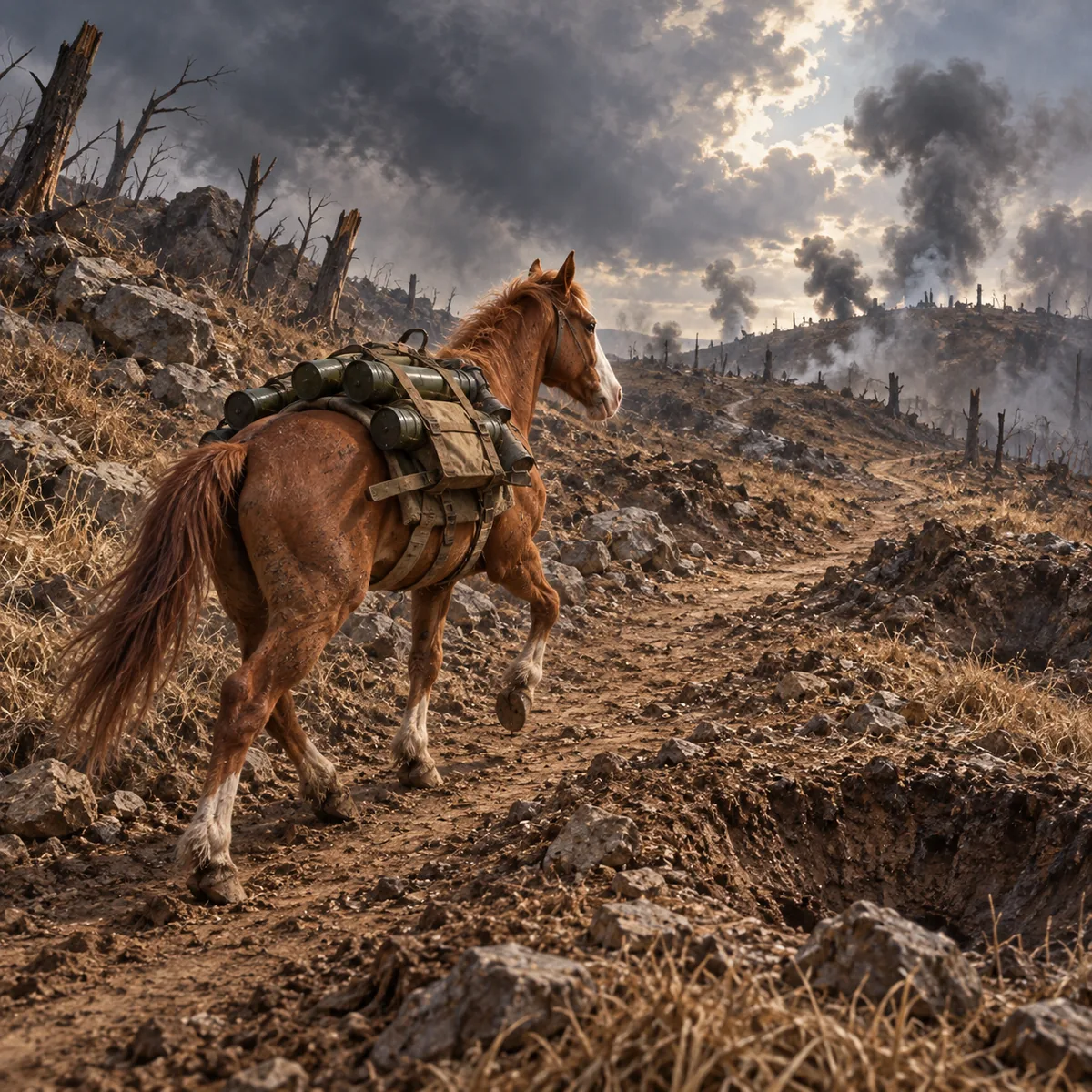
The Marines acquired Reckless in Korea and trained her as a pack horse. She learned to carry rounds for the platoon’s 75 mm recoilless rifles and to move between an ammunition point and firing positions. The 5th Marine Regiment’s history places her with the unit and traces her later promotions.
The Story
During the Vegas fighting, Marine Corps accounts say Reckless made fifty-one trips in a single day. She carried ammunition uphill, then returned toward the supply point; accounts also describe her carrying wounded Marines downhill. A Marine Corps museum account says most trips were unaccompanied, while a later Marine Corps account gives 386 recoilless-rifle rounds for that day. These figures are widely repeated in official Marine commemorations; the sources viewed here do not reproduce an original day-by-day ammunition ledger.
Reckless was wounded twice during the battle, according to the PDSA and Marine Corps accounts. Descriptions of Marines throwing their flak jackets over her emphasize their bond with the mare. The essential fact is the repeated supply movement through danger, made possible by patient training and her familiarity with the route. She did not “decide” military objectives; people placed her in harm’s way, and she kept moving through it.
What We Know — and What We Don’t
The fifty-one trips are supported by several institutional retellings, including the Marine Corps and the PDSA Dickin Medal account. The 386-round figure appears in Marine material. “Almost five tons” and “more than 9,000 pounds” also appear, but sources do not always explain whether those are ammunition weight, total carried weight, or cumulative estimates. This article therefore gives the round count with attribution and avoids converting it into a falsely precise total. Likewise, “fifty-one solo trips” is too absolute when a Marine source says most were solo.
What Happened Afterward
Reckless received promotions in the Marine Corps and ultimately held the honorary rank of staff sergeant. She went to the United States after the war and lived at Camp Pendleton until her death in 1968. Her decorations include two Purple Hearts in Marine Corps accounts. In 2016 she received a posthumous PDSA Dickin Medal. Memorial statues at Marine installations keep her story visible, including to veterans who had known her.
From History to Song
“Take the Road” follows the repeated journey rather than a single spectacular charge: ammunition uphill, a return through fire, and another climb. The song’s emotional angle is persistence and the relationship between the mare and the Marines who trained and protected her. The historical account also keeps the human responsibility in view. Reckless’ service was courageous, but the war and the route were chosen by people.
The return trip matters as much as the ascent. It could bring a wounded Marine toward help, then put Reckless in position to carry another load. Repetition, rather than an imagined moment of decision, makes the account distinctive.
Key Facts
- Animal: Staff Sergeant Reckless
- Species/breed: Horse; Korean mare, often described as a Mongolian-type horse
- Conflict: Korean War
- Country/unit: United States Marine Corps; 5th Marines, 75 mm Recoilless Rifle Platoon
- Role: Ammunition pack horse; also reported to carry wounded Marines downhill
- Key date(s): 26–30 March 1953, Outpost Vegas fighting; 1968, death
- Location(s): Outpost Vegas, Korea; later Camp Pendleton, California
- Known for: Fifty-one reported supply trips in one day
- Recognition/award: Marine Corps promotions and decorations; posthumous PDSA Dickin Medal, 2016
Sources & Further Reading
- “Staff Sergeant Reckless”, U.S. Marine Corps, 5th Marine Regiment, institutional history.
- “Museum memorial park’s first four-legged war hero unveiled”, U.S. Marine Corps, 2013.
- “Camp Pendleton unveils Staff Sgt Reckless monument”, U.S. Marine Corps, 2016.
- “Sergeant Reckless”, PDSA, award account, 2016.
- U.S. Marine Operations in Korea, 1950–1953, vol. V, Operations in West Korea, U.S. Marine Corps History and Museums Division, official history, 1972, chapter VII “Vegas,” pp. 263–312.