Introduction
Sergeant Stubby began as a stray adopted by American troops and became one of the best-known animal veterans of the First World War. The dog’s fame can make his service sound like a string of perfectly dated exploits. The firmer story is both simpler and more moving: a unit mascot lived with soldiers through gas, shellfire, injury, and the exhausting work of finding wounded men.
Stubby’s “sergeant” title was an affectionate, unofficial promotion, not proof that the Army enlisted a dog as a human soldier. That distinction allows the account to focus on what his presence meant to the 102nd Infantry Regiment and the men he accompanied.
Historical Context
The U.S. 26th “Yankee” Division reached France in 1917. Its soldiers entered a Western Front where artillery, chemical weapons, raids, and exposure threatened even when no major advance was underway. Private J. Robert Conroy had adopted Stubby while training in the United States. The dog travelled with the 102nd Infantry and became a familiar member of its daily life.
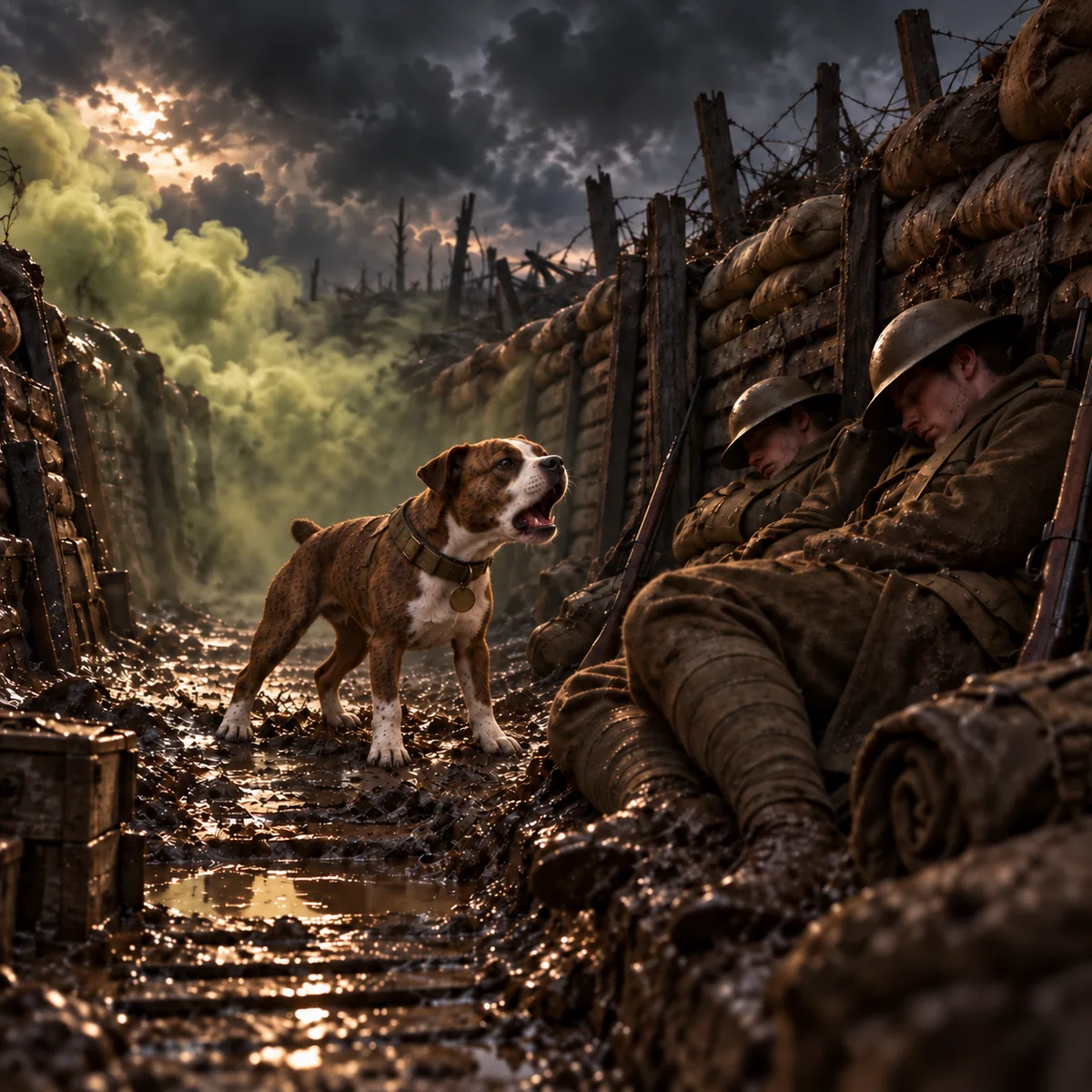
Dogs could detect odors and sounds before people noticed them. A warning from a barking dog might allow soldiers to put on gas masks or move away from danger, but it was one layer of protection in a system of sentries and alarms. Stubby was also a companion during long periods of strain.
The Story
Smithsonian accounts describe Stubby warning soldiers of gas by barking, and later finding wounded men in the field. They do not give a reliable exact day for the gas-warning episode, so it should not be assigned one. The dog himself was exposed to gas. As the war continued, his ability to locate injured soldiers became another part of his reputation; he could draw attention to someone who might otherwise be missed.
A firm date attaches to a serious wound: Stubby was hit by shrapnel at Seicheprey on 20 April 1918. The Smithsonian collection record calls it a grenade attack and describes wounds to his chest and leg. The museum’s First World War animal history calls it shellfire and says he went from a field hospital to a Red Cross hospital. Both accounts place him among wounded soldiers during recovery. Stubby later returned to his unit.
Another popular episode says Stubby detained a German infiltrator or spy and received his sergeant title afterward. The National Museum of American History repeats the story and explicitly calls the promotion unofficial. That framing is preferable to treating the title as a formal rank. His service may be counted as seventeen battles in some summaries, but such totals depend on how actions are classified; they should not become the measure of his value.
What We Know — and What We Don’t
Stubby’s attachment to Conroy and the 102nd Infantry, his gas exposure, his severe April wound, and his postwar fame are supported by Smithsonian collection research. Gas warnings and locating wounded soldiers are consistent themes in institutional accounts. The exact timing and sequence of individual warning episodes are not securely fixed in the sources used here. Two Smithsonian accounts also differ over whether the 20 April shrapnel came from a grenade or a shell; the later hospital transfer appears only in the museum’s broader article. The spy story belongs to his public history, but the dramatic dialogue often attached to it should be treated as later retelling.
What Happened Afterward
Stubby returned to the United States with Conroy. He appeared in parades, met public figures, and became associated with Georgetown University while Conroy studied there. He died in 1926. A Smithsonian Archives photograph record dates Conroy’s presentation of Stubby’s preserved remains to the United States National Museum to 1956. The collection now invites visitors to ask how a mascot became a national symbol of wartime service.
From History to Song
“Wake the Line” takes its cue from warning: the bark that causes tired soldiers to look up, mask, or search for an injured comrade. The song’s historical center is alertness shared between species under extreme pressure. Stubby’s celebrity belongs after that experience. His story asks readers to remember the unphotographed hours when a dog’s presence could steady a unit as much as a single celebrated act.
Seicheprey gives the narrative a dated turning point, while the gas warning remains deliberately undated. That division protects the song's emotional truth from a false timeline and leaves room for the later hospital visits that mattered to wounded men.
Key Facts
- Animal: Sergeant Stubby
- Species/breed: Dog, commonly described as a Staffordshire terrier mix
- Conflict: First World War
- Country/unit: United States; 102nd Infantry Regiment, 26th Division
- Role: Mascot; reported gas warning and casualty location
- Key date(s): 20 April 1918, serious shrapnel wound; 1926, death
- Location(s): France; United States after the war
- Known for: Battlefield companionship, warnings, and recovery from injury
- Recognition/award: Unofficial “sergeant” title; public decorations and commemoration
Sources & Further Reading
- “How did animals (even slugs) serve in World War I?”, National Museum of American History, 2014.
- “Stubby” collection object, National Museum of American History, collection record; date not stated.
- “Presentation of World War I Mascot ‘Stubby’”, Smithsonian Institution Archives, photograph and record, 1956.