
Introduction
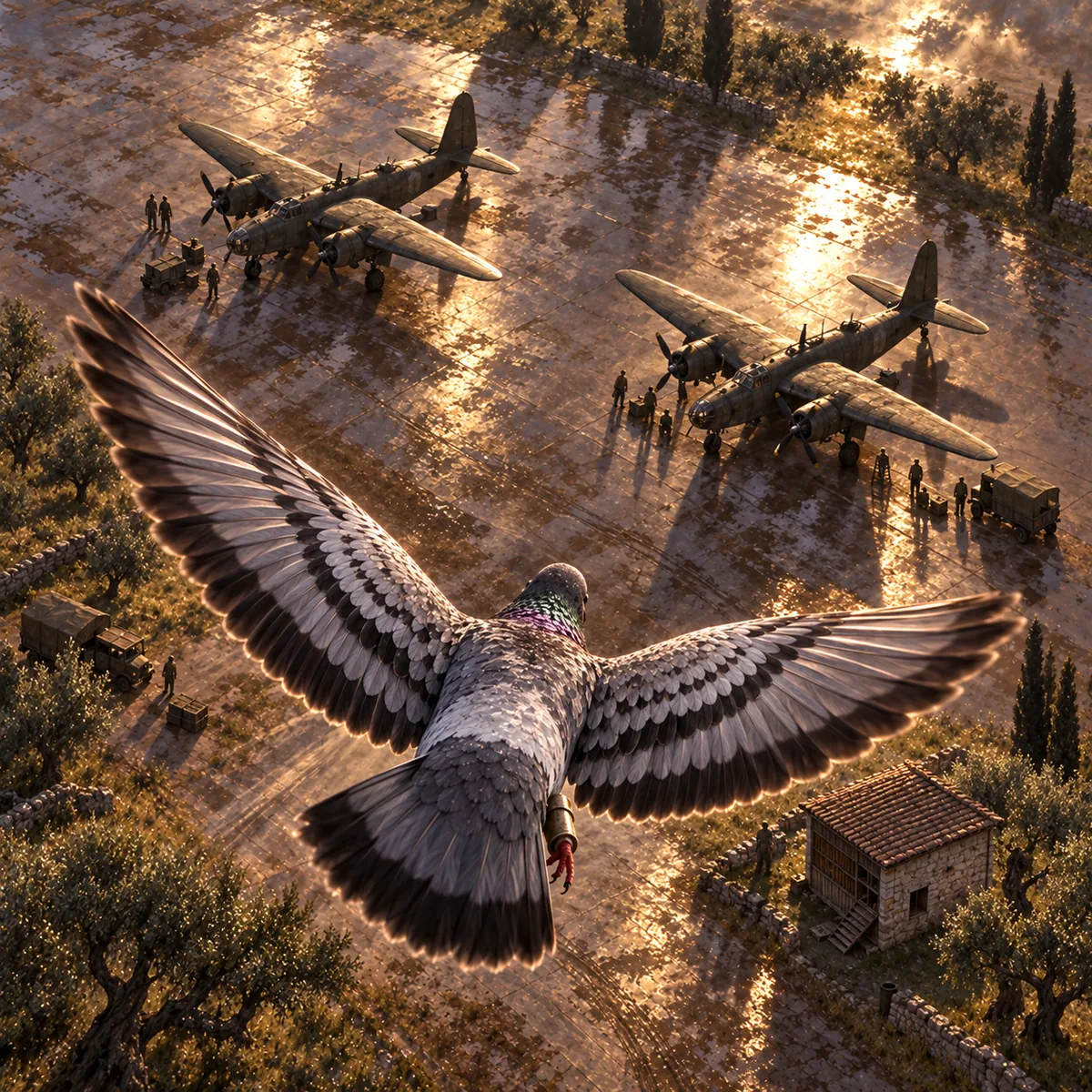
Cher Ami is often described as the pigeon who saved the Lost Battalion. The familiar image is unforgettable: a wounded bird returning with a message tube dangling from a nearly severed leg. A real injured messenger pigeon did make an extraordinary flight in 1918. Whether Cher Ami carried the Lost Battalion’s specific plea on 4 October is less certain than many accounts suggest.
That distinction matters because the bird’s documented service needs no invented certainty. Cher Ami carried vital wartime messages and survived catastrophic injuries long enough to return to a loft. The Lost Battalion’s ordeal also deserves to be understood on its own terms.
Historical Context
During the Meuse-Argonne Offensive, American units advanced into the Argonne Forest amid difficult terrain and broken communications. A composite force of the 77th Division under Major Charles W. Whittlesey pushed ahead of neighboring units in early October 1918. German forces surrounded the Americans. Food, water, and ammunition dwindled while casualties mounted. Their position was so poorly understood behind the lines that American artillery fell on them.
Pigeons offered a way to send short messages when runners or wires could not get through. Whittlesey sent several notes on 3 and 4 October. One message gave the position and the danger: “We are along the road parallel 276.4. Our own artillery is dropping a barrage directly on us. For heaven’s sake stop it.” Its location information helped the effort to relieve the surrounded force on the night of 7 October. The Smithsonian’s collection account notes that the shelling had already ceased by the time the wounded pigeon reached its loft; the bird should not be credited with single-handedly stopping it.
The Story
Cher Ami was an English-bred homing pigeon in the U.S. Army Signal Corps pigeon service. The bird’s leg band, NURP 18 EAD 615, allows a firmer identification than the many retellings that followed. A February 1919 Army record credits Cher Ami with twelve important messages from the Verdun front. It describes a final return with the right leg nearly lost, a wound through the breast, and a message tube still attached.
The celebrated Lost Battalion flight is dated 4 October 1918 in later accounts. Smithsonian historian Frank A. Blazich Jr. has examined the surviving military records and found that they do not identify by name which pigeon carried Whittlesey’s crucial afternoon message. The public connection to Cher Ami was made after the war, when a Signal Corps officer presented the bird to the press as the Lost Battalion’s savior. This may preserve a true identification, but it is not proven by the surviving dispatch record.
The wounded bird received care and was eventually sent to the United States. Accounts sometimes describe elaborate surgery or a tiny wooden leg; the core contemporary record is simpler and stronger: Cher Ami returned badly injured with a message and survived long enough to become a public symbol of the pigeon service.
What We Know — and What We Don’t
The Lost Battalion, the friendly-fire message, Cher Ami’s service, and Cher Ami’s severe wounds are documented. The identity of the 4 October carrier remains unresolved. The Smithsonian also reports conflicting contemporary descriptions of the bird’s sex. An Army form called Cher Ami a hen; later DNA research identified the preserved specimen as male. Numbers describing the battalion’s initial strength and losses vary according to which attached units and time span are counted, so a single “lives saved” total would mislead.
The French Croix de Guerre is widely associated with Cher Ami. Smithsonian material records that recognition, but the historical question at the center of this story is the message attribution, not whether the bird was admired.
What Happened Afterward
Cher Ami arrived in the United States in April 1919 and died on 13 June that year. The Signal Corps gave the remains to the Smithsonian, where the mounted bird became a lasting memorial to military pigeons. The museum’s recent research has made Cher Ami more interesting, not less: a famous object can carry both a verifiable history and an uncertain public legend.
From History to Song
“Through the Iron Rain” centers on a small messenger moving through a battle that no animal chose. The song’s emotional force comes from the wounded return and the human need for a location to be known. The article keeps the historical boundary clear: Cher Ami’s injured flight is real, while the exact connection to Whittlesey’s best-known note remains unproven. That uncertainty is part of the story of how sacrifice becomes national memory.
The track title evokes the artillery environment without turning the bird into a fictional eyewitness to every moment in the ravine. What survives in the record is a wounded messenger and a group of surrounded soldiers whose location had to reach others.
Key Facts
- Animal: Cher Ami, band NURP 18 EAD 615
- Species/breed: Homing pigeon
- Conflict: First World War
- Country/unit: U.S. Army Signal Corps pigeon service; associated with the 77th Division
- Role: Messenger
- Key date(s): 4 October 1918, Lost Battalion message; 13 June 1919, Cher Ami’s death
- Location(s): Argonne and Verdun sectors, France; Washington, D.C.
- Known for: Wounded return with an important message; disputed identification as the Lost Battalion’s final messenger
- Recognition/award: French Croix de Guerre reported by the Smithsonian; preserved in the Smithsonian collection
Sources & Further Reading
- “Cher Ami” collection object, Smithsonian Institution, collection research; date not stated.
- “Notre Cher Ami: The Enduring Myth and Memory of a Humble Pigeon”, Frank A. Blazich Jr., Journal of Military History 85, no. 3 (2021): 646–677; Smithsonian research record.