Introduction
Few wartime animal stories have travelled as far as the black-and-white cat said to have survived three ship losses in 1941. In the familiar telling, Oscar escaped the German battleship Bismarck, the British destroyer HMS Cossack, and the carrier HMS Ark Royal. The nickname “Unsinkable Sam” turns that itinerary into a neat tale of survival.
The ships and their losses are real. The cat’s complete passage between them is much harder to prove. Oscar is therefore a useful case in how wartime memory works: a portrait and a popular story preserve an animal whom the surviving operational record does not securely trace.
Historical Context
In May 1941, Bismarck entered the Atlantic to threaten Allied shipping. British forces pursued her after she sank HMS Hood. Aircraft from Ark Royal damaged the battleship’s steering on 26 May, and British warships sank her on 27 May. The human loss was immense. Royal Museums Greenwich’s account of the battle documents this sequence.
The later ship losses happened in a different phase of the war at sea. Cossack was torpedoed in October and sank on 27 October 1941. Ark Royal was torpedoed on 13 November and sank on 14 November. The Imperial War Museums catalogue of an Admiralty photograph distinguishes the torpedo attack from the sinking the following day.
The Story
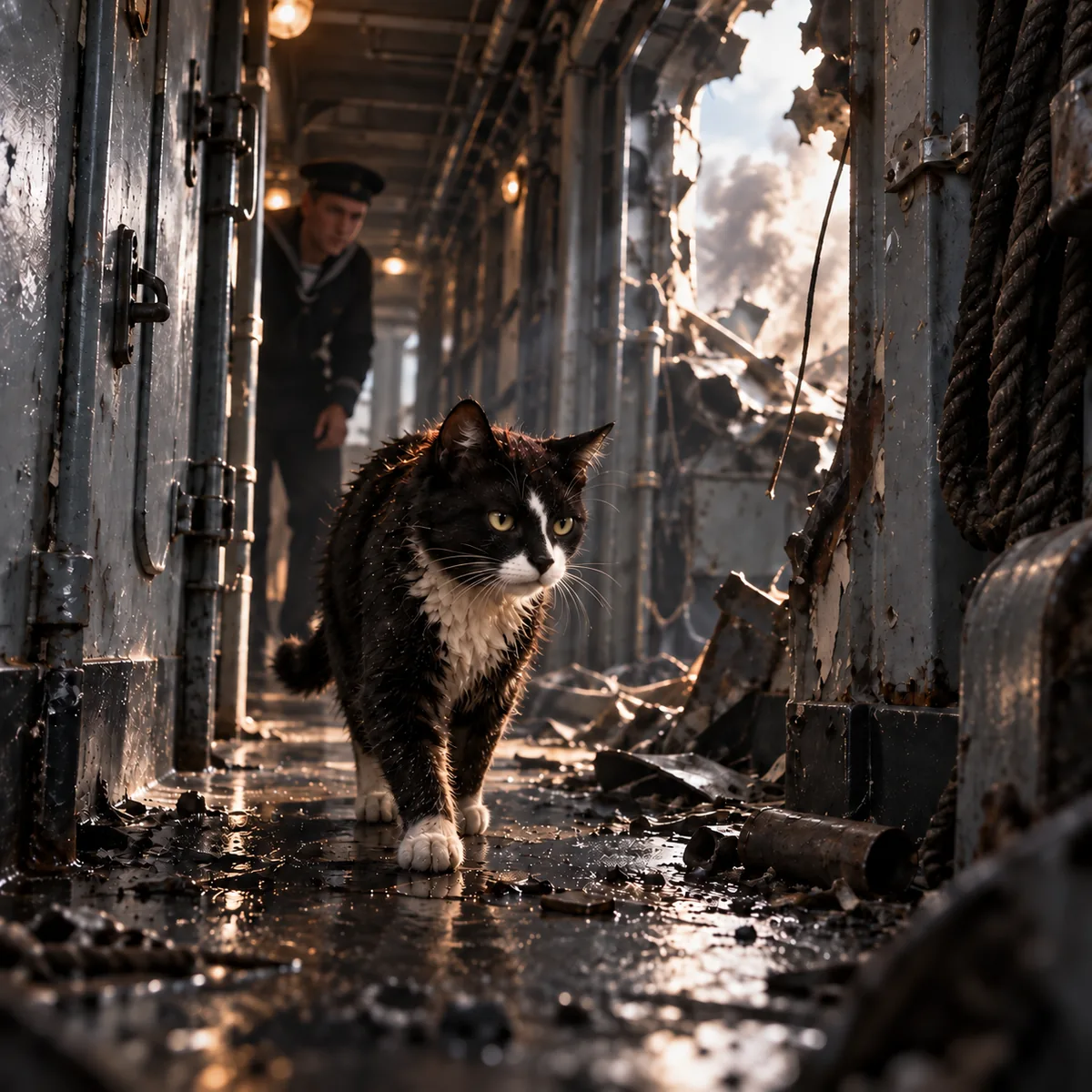
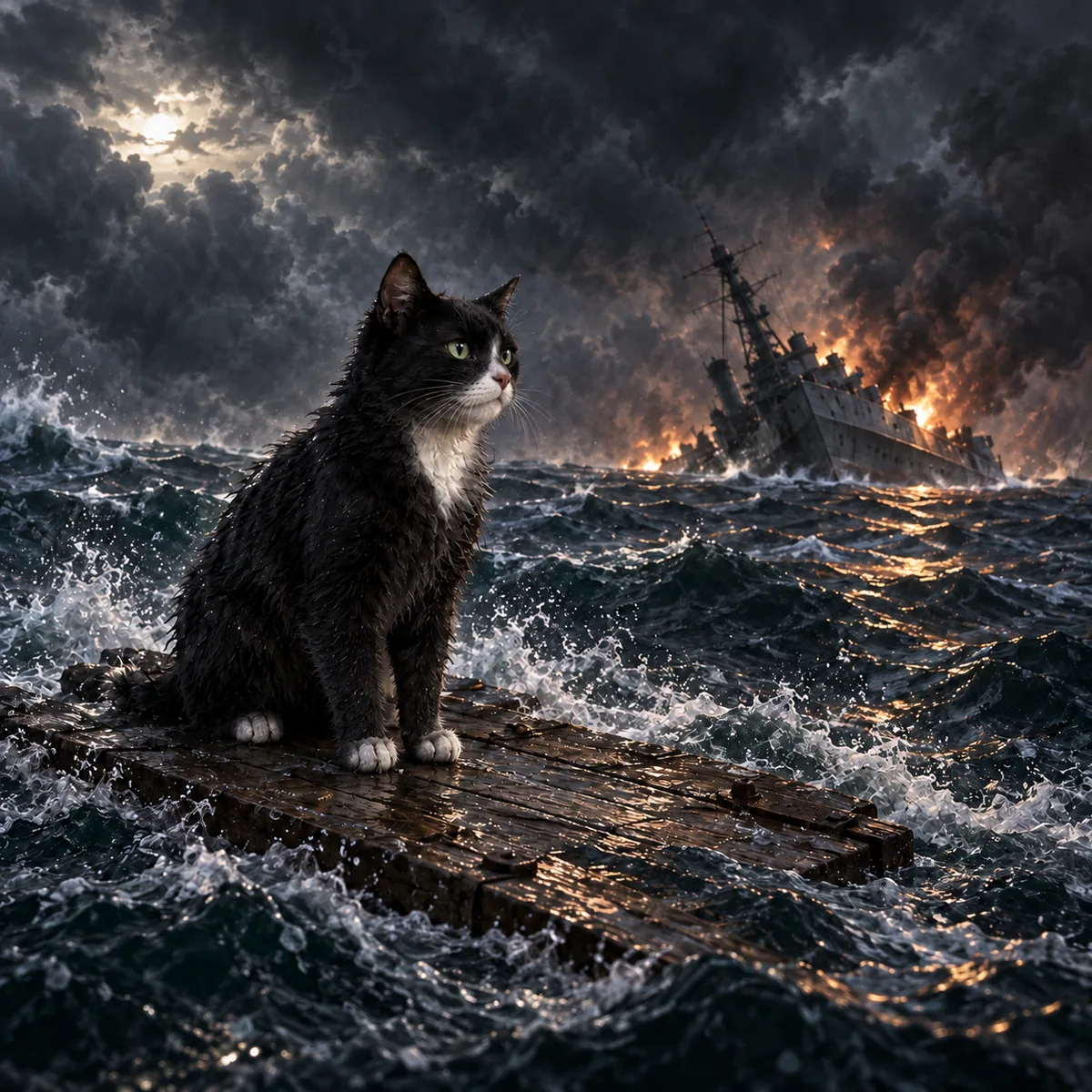
The legend of Unsinkable Sam begins with a cat supposedly found on floating wreckage after Bismarck sank and brought aboard Cossack. When that destroyer was lost, the same cat supposedly survived again, reached Gibraltar, and joined Ark Royal. A third rescue after the carrier’s sinking reportedly ended his sea service. The story usually finishes with Oscar spending the rest of the war ashore and dying in Belfast in 1955.
A tangible object keeps the story in public view. Royal Museums Greenwich holds Georgina Shaw Baker’s pastel image of a black-and-white cat on wreckage, catalogued as “Oscar, cat from the German battleship ‘Bismarck’”. Its catalogue recounts the three-ship narrative, but also acknowledges doubts about Oscar’s origin on Bismarck. The portrait is evidence that Oscar’s story was told and commemorated; it does not, by itself, establish every movement of a particular cat.
What We Know — and What We Don’t
The strongest documentary anchors are the dated ship losses and the museum-held portrait. Royal Museums Greenwich notes that it knows of no Bismarck survivor account identifying the cat. It also flags two contradictory photographs circulated as Oscar: one depicts a tabby, while another depicts a black-and-white cat wearing a tag marked HMS Amethyst 1949. That second animal would belong to Simon’s era, eight years later.
No continuous set of ship records in the cited sources identifies one cat aboard all three ships. The account of Cossack picking up a Bismarck cat, the transfers, and the Belfast ending should be introduced as reported tradition. The portrait makes it reasonable to say an Oscar story circulated; it cannot repair gaps in that story’s chain of custody. Even the word “unsinkable” is a nickname, not an account of what happened to the people aboard those vessels.
What Happened Afterward
Oscar’s later life is usually placed in Gibraltar and then a Belfast seamen’s home. Those details appear in the Greenwich catalogue narrative, but should remain qualified because the earlier identity problem follows the cat ashore. The enduring legacy is the portrait and the continuing effort to separate commemoration from proof. Simon, another naval cat in this archive, offers a useful comparison: his shipboard award has a contemporary citation and a clearer record.
From History to Song
“Unsinkable Sam” can carry two truths at once: sailors could find comfort in a surviving animal, and a good story can become firmer in memory than in the archive. The song’s historical angle is the precariousness of survival at sea, with the cat’s disputed itinerary left visible rather than resolved by invention. It invites listeners to remember the crews of Bismarck, Cossack, and Ark Royal while asking how legends form around catastrophe.
Its title preserves the nickname by which generations have met Oscar. The archive beside it supplies the essential qualification: the vessels' sinking dates are certain, but a single cat's presence on each ship is not. That tension is part of the music's subject.
Key Facts
- Animal: Oscar, also called Unsinkable Sam
- Species/breed: Domestic cat; precise identity disputed
- Conflict: Second World War
- Country/unit: Alleged association with German and British naval vessels
- Role: Reported ship’s cat
- Key date(s): 27 May, 27 October, and 14 November 1941 are ship-loss dates, not verified dates in a continuous cat service record
- Location(s): North Atlantic; Gibraltar; Belfast in the later telling
- Known for: The legend of surviving three ship losses
- Recognition/award: No verified military award; portrait in the National Maritime Museum collection
Sources & Further Reading
- “Oscar, cat from the German battleship ‘Bismarck’”, Royal Museums Greenwich, collection object PAJ2744; date not stated.
- “The Sinking of the ‘Bismarck’, 27 May 1941”, Royal Museums Greenwich, collection essay updated June 2024.
- The sinking of HMS Ark Royal, Imperial War Museums, Admiralty photograph A 6315, 13 November 1941; catalogue records the sinking the following day.