Introduction
Gander travelled from Newfoundland to Hong Kong with the Royal Rifles of Canada in 1941. A large Newfoundland dog, he was loved as a mascot and remembered for protecting soldiers during the colony’s defence. The account that brought him the PDSA Dickin Medal says he carried an enemy grenade away from wounded Canadians and died when it exploded.
It is tempting to pin that moment to 19 December 1941, a date often associated with severe fighting on Hong Kong Island. The strongest official accounts consulted here give only December. The exact day should remain open unless a contemporary unit record or eyewitness document can establish it.
Historical Context
Japan attacked Hong Kong on 8 December 1941. The Royal Rifles of Canada and Winnipeg Grenadiers had reached the British colony only weeks earlier. They fought with British and other Commonwealth units as Japanese forces crossed to Hong Kong Island. The defenders were overwhelmed and the colony surrendered on 25 December. The Veterans Affairs Canada history places the Canadian units and campaign in context.
Gander had lived near the airfield at Gander, Newfoundland. The Hayden family gave him to the Royal Rifles, where he became the regiment’s mascot. Veterans Affairs Canada records soldier Fred Kelly’s care of the dog, including ways he kept the heavily coated Newfoundland cool in Hong Kong’s climate. A mascot was a reminder of ordinary life for men far from home.
The Story
During the fighting, Gander was reportedly involved in several encounters with Japanese troops. The PDSA citation credits him with three occasions of direct engagement and says two of his attacks halted an advance and protected wounded men. Such award language records the testimony on which he was honored; it does not provide an hour-by-hour battle diary for the dog.
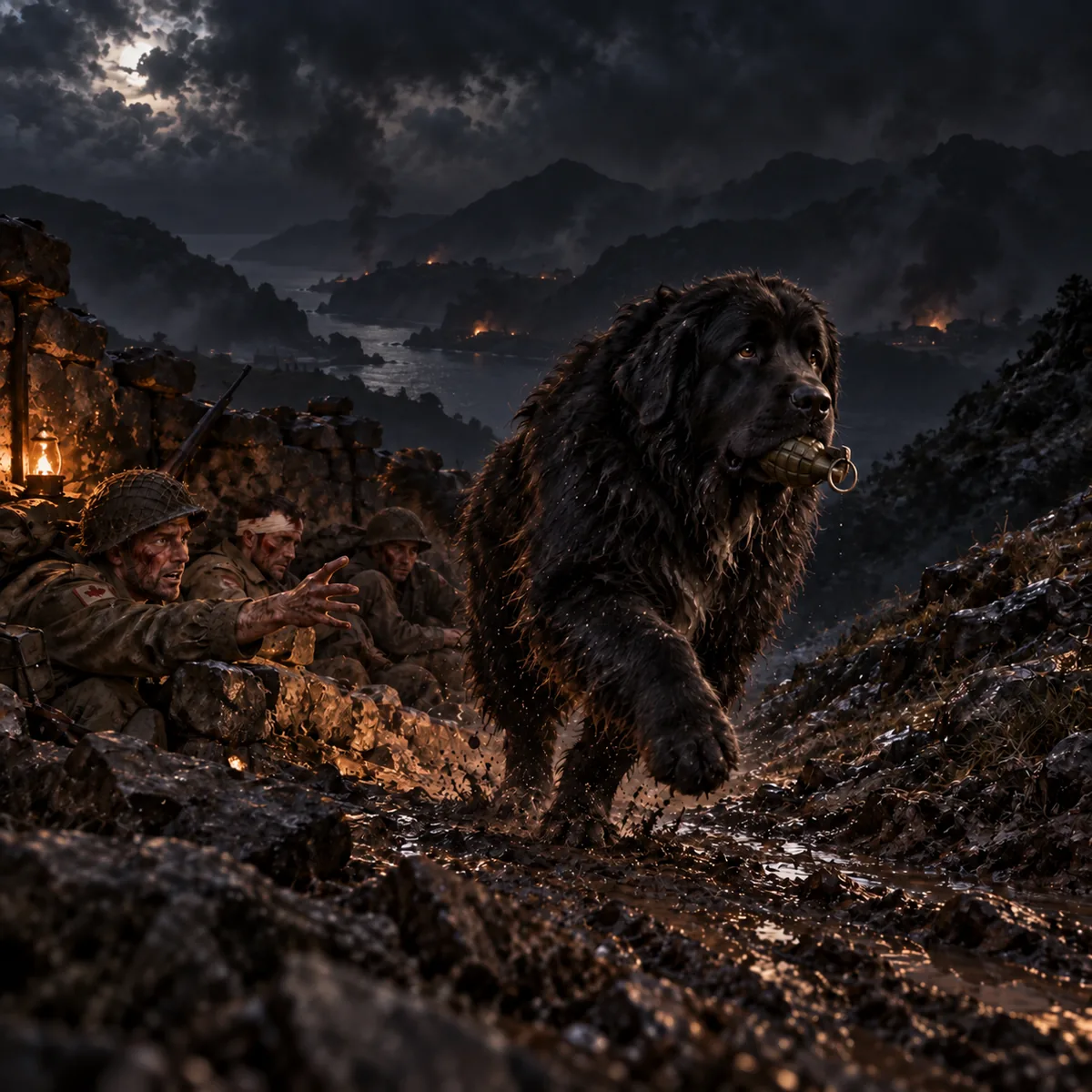
The final action is the best known. A grenade landed near wounded Canadians. According to the PDSA and Veterans Affairs Canada, Gander picked it up and moved away from the men. It exploded, killing him. Veterans Affairs Canada says seven soldiers were saved. The account expresses how the survivors and their regimental community remembered the dog: he acted in a way that removed an immediate threat from men who could not readily escape it.
Readers should also know that another, separately documented grenade sacrifice occurred in the same campaign. Company Sergeant-Major John Robert Osborn of the Winnipeg Grenadiers died shielding comrades from a grenade on 19 December. His Victoria Cross citation fixes that date. The existence of Osborn’s action does not disprove Gander’s; it is one reason to avoid borrowing 19 December for the dog without an independent source.
What We Know — and What We Don’t
Gander’s unit association, death in the Hong Kong fighting, medal citation, and memorialization are well established. His exact death date and exact place within the island fighting are less secure in the consulted institutional accounts. The PDSA’s dramatic description of the grenade and the seven-man figure come from later recognition and veterans’ recollection. They should be attributed rather than treated as a contemporary casualty ledger.
What Happened Afterward
Gander received a posthumous Dickin Medal on 27 October 2000 after work by Hong Kong veterans’ organizations and the Canadian War Museum. His name is included on Canada’s Defence of Hong Kong Memorial Wall, among the people who served there. The memorial’s inclusion says something about how strongly survivors considered him part of their unit.
From History to Song
“Out of the Dark” evokes the night fighting and the sudden danger of a grenade near wounded men. Its historical heart is an animal embedded in a regiment, not a solitary fantasy hero. Gander’s story allows the song to honor both the dog and the Canadian soldiers who remembered him, while leaving the exact calendar day in the category the evidence supports: December 1941.
The track can also hold the distance between Newfoundland and Hong Kong, a journey shared by the dog and the Royal Rifles. That distance helps explain why a familiar mascot mattered so deeply when the regiment found itself under attack far from home.
Key Facts
- Animal: Gander, originally Pal
- Species/breed: Newfoundland dog
- Conflict: Second World War
- Country/unit: Canada; 1st Battalion, Royal Rifles of Canada
- Role: Regimental mascot
- Key date(s): December 1941, death during Hong Kong defence; 27 October 2000, Dickin Medal
- Location(s): Gander, Newfoundland; Hong Kong
- Known for: Reported removal of a grenade from wounded Canadian soldiers
- Recognition/award: Posthumous PDSA Dickin Medal; named on Defence of Hong Kong Memorial Wall
Sources & Further Reading
- “Gander”, PDSA, Dickin Medal record, 2000.
- “Mascot Dog Sacrificed Life for Human Comrades”, Veterans Affairs Canada, educational history; date not stated.
- “Defence of Hong Kong Memorial Wall”, Canadian Heritage, memorial record, 2009.
- “John Robert Osborn”, Canadian Department of National Defence, Victoria Cross citation.
- “Newsletter June 2000”, Hong Kong Veterans Commemorative Association, June 2000; includes the earlier name Pal.